Extractions Are Not Called Pulling Teeth For Nothing!
Pet owners are occasionally surprised when I quote them the price of dental extractions. I think some people have the impression that the extraction of a tooth is simply yanking on it with a set of pliers, while others tell me that they has their last vet only charge $10 per tooth or some other ridiculously low price. To the former, I say that extracting teeth is intricate and involved oral surgery. To the latter, I say that they should call their old vet back and ask them if they perform the procedure correctly, that is:
1.) Preoperative X-ray.
2.) Gingival Flap.
3.) Sectioning the Tooth (in the case of a multiple root tooth).
4.) Post Operative X-ray.
5.) Suture Closed
To this day, I still have yet to hear that any veterinarian performs tooth extractions at this standard and charges significantly less than I do, although I know of several that charge $10 per tooth and do not even have dental x-ray, let alone perform these other invaluable steps. Each step is equally important to properly extract teeth with minimal pain and complications.
Preoperative X-ray
 This is extremely important first and foremost because, while externally observed dental lesions commonly have damage at the root level, not all do. In addition to confirming that a tooth is indeed a health liability and source of pain, a preoperative x-ray enables the veterinary oral surgeon the opportunity to take precautions in the event of special anatomical considerations. These considerations may include curved roots, ultra-thin jaw bone, or a root located dangerously close to the root of a healthy tooth. Pictured here is a tooth (the largest one in the center) with the root at the right illustrating resorption of the surrounding bone due to damage to the tooth’s crown.
Gingival Flap
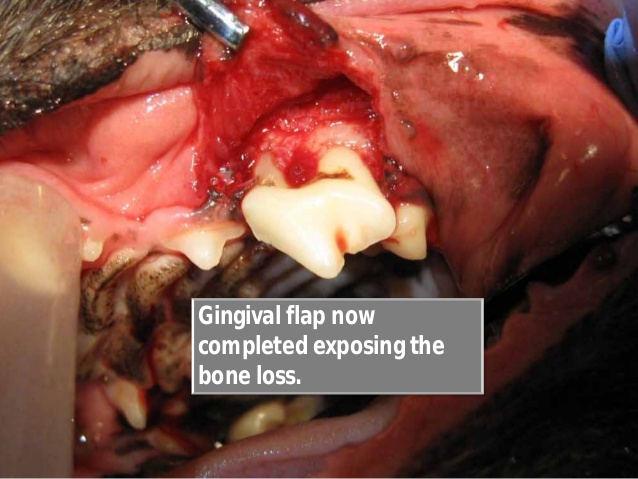 The surgical procedure known as a gingival flap allows for exposure to the bone surrounding the root beneath the gum line. This enables the veterinary oral surgeon access to carefully burr away just the bone immediately surrounding the tooth root. This minimizes damage to the surrounding jaw bone due to the increased precision it permits.
Sectioning The Tooth
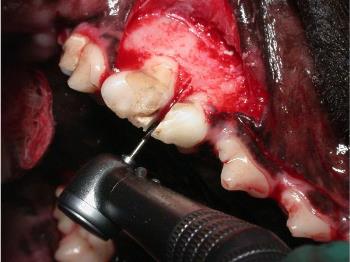 In multi-root teeth, once the roots are exposed, to extract the teeth with the most ease and to avoid breaking of roots during extraction, the tooth is cut or sectioned to enable extraction of one root at a time.
Post-operative X-ray
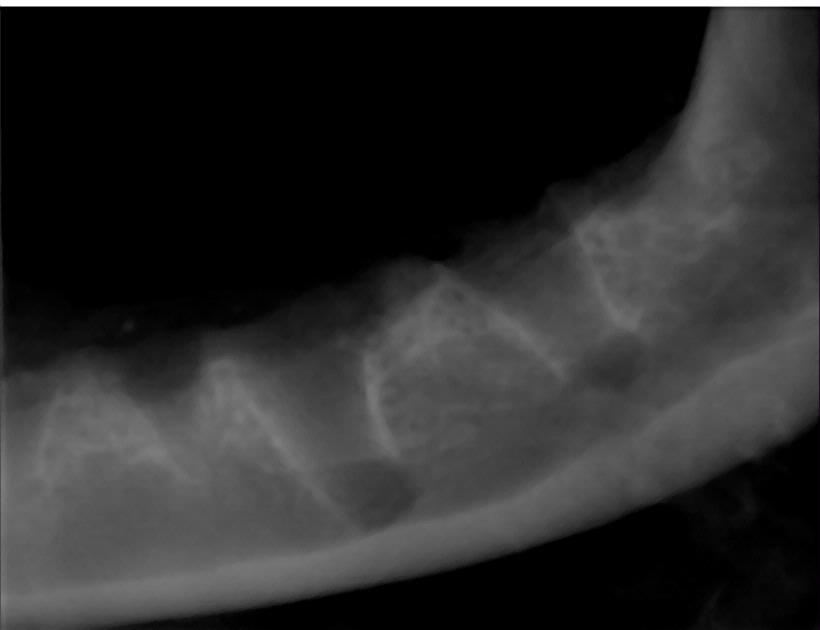 Post-operative x-ray enables the veterinary oral surgeon to confirm that no root fragments were left behind following the extraction. This may be the most important step, as root fragments left behind would be a source of chronic pain and bone infection for month or years to come! In this example, both root spaces are clear with no retained root material.
(See Related: The Number Once Act Of Malpractice In Veterinary Medicine)
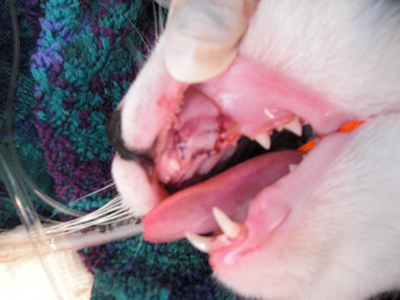 Suture Closed
The gingival flap following an extraction has to be carefully closed so that the gum can heal and seal to the bone once again. Ideally, high grade absorbable suture should be used that has great strength to keep gum tissue opposed in the mouth as it heals, but dissolved in a timely fashion within a few days of complete heal.
Oral surgery for the extraction of diseased teeth is very rewarding for its health benefits to the patient. Decaying teeth are not only a source of pain that a dog or cat suffers silently with, but they are serious lesions that suppress the immune and predispose to kidney failure and heart valve infections. It is not, however, easy. Some of the most labor intensive surgeries that I have been involved in have been oral surgery to extract diseased teeth.
Dr. Roger Welton is the President of Maybeck Animal Hospital in West Melbourne, FL, Chief Editor of the Veterinary Advice and Information Website, Web-DVM, and founder/CEO of Dr. Roger’s Holistic Veterinary Care.

Keep your pets safe this holiday season!
The holiday season is right around the corner starting with Halloween (yes, in my home, we consider Halloween a holiday!). It is both a joyous and busy time and it can be easy to overlook certain...

Help for nervous/anxious dogs
There seems to be a growing number of excessively nervous, often skittish dogs. This can range from anxieties, such as noise or storm anxiety, anxiousness about being separated from pet parents,...
Bird flu is infecting cats and cases are rising – What you need to know!
H5N1 Avian Influenza is causing far more trouble than just just high egg prices. The bird flu has successfully jumped species now able to infect cats and people. Although the ability to infect...

Read Dr. Roger’s Latest Book!
 Be Healthy & Fit With Celebrity Trainer Steve Jordan
- The New Measure of a Life Well Lived: Why Health Span Matters More Than Longevity
- The Wealth Spark: Igniting Your Path To Abundance and Success
- Bright Line Eating with New York Times best selling author Dr. Susan Peirce Thompson
- Maximizing Your Workout Time: Efficiency Tips from Westwood Private Fitness
- How to Transform Your Dad Bod: Insights from the Fit Father Project – New Podcast Episode Out Now!