Heart Murmur
My pet has a heart murmur – what does this mean?
A heart murmur is one of several types of abnormal swishy sounds your veterinarian can hear when listening to your pet’s heart with a stethoscope. Normally, two distinct sounds are heard when listening to the heart of a normal dog or cat, often described as “lub” and “dub”. When listening with a stethoscope one hears: Lub-dub…Lub-dub….Lub-dub, which we call a “normal sinus rhythm.” A heart murmur is an abnormal extra sound (which can sometimes muffle out the normal sounds). Heaart murmurs most commonly occur in dogs and cats between the “lub” and the “dub” and have the aforementioned swishy quality.
Hearing a heart murmur during a routine physical examination will often be the first inclincation to your veterinarian that your pet may have heart disease. Hearing a murmur is only a hint that something may be wrong wiht the heart, what we term a clinical sign, but not a final diagnosis. Hearing a heart murmur is reason to consider more discussion and tests to determine the cause of the murmur (the diagnosis). Knowing the diagnosis and severity of the cause of the murmur allows your veterinarian (or a veterinary cardiologist they consult) to provide you with a diagnosis and prognosis regarding how this heart problem may effect your pet in the future.
Hearing a heart murmur is not necessarily a reason to for grave concern. Many dogs and cats with murmurs live normal lives and never require any treatment for heart disease. However, the only way to know for certain is to work with your veterinarian to determine the cause and severity of the cause of the murmur.
What causes a heart murmur?
The quick answer to this question is “turbulent blood flow.” Like the water in a calm river or stream, blood flowing normally flows through the heart with what we term laminar flow, which is essentially smooth and undisturbed flow. Also like a river or stream, narrowing or other causes of more rapid flow will disrupt smooth laminar flow. For example, a river the turbulent rapids create sounds much louder and less tranquil than the calmer sections of river. In the heart we hear this turbulence as a heart murmur.
There are lots of things that can cause turbulent blood flow. To understand what can cause turbulent flow we need a brief lesson in heart anatomy and function:
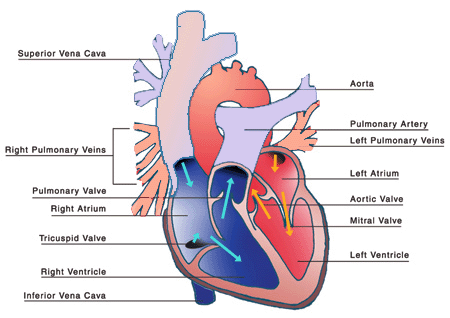
In Figure 1 below, we can see that a dog’s or cat’s heart has four chambers – two two upper chamber called, atria and two lower chambers called ventricles (one of each on each side). Blood initially enters the heart in the right atrium. The blood then passes through the tricuspid valve into the right ventricle which pumps the blood through the pulmonic valve into the lungs to pick up oxygen. The oxygenated blood then enters the left atrium. Blood in the left atrium passes through the mitral valve to reach the left ventricle, which then pumps the blood through the aortic valve out to the rest of the body to oxygenate its tissues.
The purpose of each of the valves (tricuspid, pulmonic, mitral, aortic) is to keep the blood flowing forward, not backward, through the circuit described above (RA->RV-> lung > LA>LV>body). If a valve malfunctions (e.g., it doesn’t open or close properly), it can disturb blood flowing through it enough to create turbulence and the result is that your veterinarian will hear a heart murmur. The most common heart murmurs in dogs are associated with leaky mitral valves.
 In other cases, the turbulence develops because there is a “hole in the heart” between two chambers or that are not normally connected and communicating with one another.
Another cause is a narrowing within a chamber or vessel through which the blood has to “squeeze” through, like water through a pinched hose. We term this phenomenon stenosis.
In other cases, turbulence can be heard when the blood is too “thin” (which can occur deficient rebd blood cells, aka, anemia) or even when a patient is very excited causing the heart to pump faster and harder than normal.
What is a benign or “innocent” murmur?
Some heart murmurs are called benign (or innocent), meaning there is no apparent heart disease that explains the murmur. These murmurs are occasional seen in puppies, and can occur in cats of any age. They are uncommon in adult dogs. Benign murmurs are usually soft (rather than loud), and can be intermittent, not consistently heard. Benign puppy murmurs will generally disappear by 12 to 15 weeks of age. Murmurs associated with anemia or excitement are also considered benign murmurs.
What is a congenital murmur vs. an acquired murmur?
A congenital heart murmur is a genetically inherited defect of one or more heart valves, or holes in the the walls of 2 heart chambers that create a communication that should not be there. An acquired murmur is not genetic, and is cause by other factors, such as heart valve infection, anemia, or certain other systemic disease (such as hyperthyroidism in cats).
My pet’s murmur has a “grade.” What does this mean?
Murmur grading is simply your veterinarian’s way of describing the intensity of a heart murmur. There are six heart murmur grades. The lower the grade, the more quiet the murmur. However, others will simply describe them as “soft,” “moderate,” or “loud.” There are other terms that a vet will use to describe the distinct character of a murmur – this helps communicate to other veterinarians the characteristics of the murmur as certain types of murmurs are more common associated with specific heart or valve diseases.
The grade or loudness of a heart murmur does not always correlate with the severity of the heart abnormality causing it.
It is important to consider that grading is ultrimately to some degree subjective because it is based on how it sounds to the listener. Grade is in the “ear of the beholder.” Also, it can be hard to tell if an animal has a heart murmur if the pet is excited or anxious because rapid breathing sounds can mimic a murmur. Cats purring during an exam, for example, can significantly hinder the veterinarian’s ability to pick up on, and/or grade a heart murmur. Grade 1 out ot 6 murmurs, can be especially difficult to hear. A Grade 5 or Grade 6 murmur is so strong that it can be felt through the chest wall, terms a “thrill.”
What should I do if my pet has a murmur?
Dogs
In many cases, a veterinarian will be able to determine the likely cause of a murmur in a dog just by listening. In some cases, no additional testing will be deemed necessary. However, to be certain, it is often best to work with your veterinarian to confirm the specific source of the murmur as well as the severity of the condition that is causing the murmur. This will give you the best idea of what to expect in the future — the prognosis for your pet. In other cases, where a pet may be used for breeding, a murmur may indicate the presence of a hereditary defect that could be passed on to progeny. Breeding these animals is considered an egregious breech of ethics.
Cats
The cause of a cat’s murmur cannot usually be determined by listening alone. In many cats, benign murmurs can sound exactly like murmurs in a cat with serious heart disease. Heart murmurs in cats can be caused by a disease called hyperthyroidism, and often resolve with treatment.
In both dogs and cats, your veterinarian will commonly elect to perform chest radiographs (x-rays) measure the heart sillouette, and pulmonary blood vessles, and check for fluid in the lungs that may suggest congestive heart failure. A simple blood test may be run called proBNP measures a protein that is released into the blood stream by diseased heart muscle.
You veterinarian may also recommend a cardiac ultrasound, known as an echocardiogram. This enables recognition of the distinct location of the defect, as well as its magnitude. Echocradiogram also measures heart muscle thickness and the efficiency of the heart contraction.
How is a murmur treated?
The murmur itself is with few exceptions, is generally not treated. The underlying cause of the murmur may or may not be treated – this depends on the cause, severity, and other circumstances (age, well-being of the pet, cost of treatment etc). Your veterinarian is best suited to discuss specific treatment options with you.
See also, CONGESTIVE HEART FAILURE.
Roger L. Welton, DVM
Founder and Chief Editor, Web-DVM.net
Author, The Man in the White Coat
Article updated 6/17/2026
19 thoughts on “Heart Murmur”
Leave a Reply

Keep your pets safe this holiday season!
The holiday season is right around the corner starting with Halloween (yes, in my home, we consider Halloween a holiday!). It is both a joyous and busy time and it can be easy to overlook certain...

Help for nervous/anxious dogs
There seems to be a growing number of excessively nervous, often skittish dogs. This can range from anxieties, such as noise or storm anxiety, anxiousness about being separated from pet parents,...
Bird flu is infecting cats and cases are rising – What you need to know!
H5N1 Avian Influenza is causing far more trouble than just just high egg prices. The bird flu has successfully jumped species now able to infect cats and people. Although the ability to infect...

Read Dr. Roger’s Latest Book!

 Be Healthy & Fit With Celebrity Trainer Steve Jordan
- The New Measure of a Life Well Lived: Why Health Span Matters More Than Longevity
- The Wealth Spark: Igniting Your Path To Abundance and Success
- Bright Line Eating with New York Times best selling author Dr. Susan Peirce Thompson
- Maximizing Your Workout Time: Efficiency Tips from Westwood Private Fitness
- How to Transform Your Dad Bod: Insights from the Fit Father Project – New Podcast Episode Out Now!





maillot Lahm 2014
Greetings from Idaho! I’m bored to tears at work so I decided to browse your website on my iphone during lunch break. I really like the info you provide here and can’t wait to take a look when I get home. I’m surprised at how quick your blog loaded…
I am really enjoying the design and layout of your post. It is very easy on the eyes which makes it all the more pleasant for me to come here and visit more often. Have you made your own theme because whoever made the theme here is so beautiful.
1composers
gay jerk off chat https://gaytgpost.com/
indian gay chat room https://gay-buddies.com/
vegas slots free https://2-free-slots.com/
pearl warriors slots https://freeonlneslotmachine.com/
bellagio slots guide https://pennyslotmachines.org/
free slots online games https://slotmachinesforum.net/
obama slots https://slot-machine-sale.com/
ashcroft slots machines https://beat-slot-machines.com/
slots https://411slotmachine.com/
youtube slots 2022 vegas https://www-slotmachines.com/
dissertation editor near me https://buydissertationhelp.com/
chicago citation dissertation https://dissertationwriting-service.com/
dissertation proposal outline https://help-with-dissertations.com/
doctorate degree without dissertation https://mydissertationwritinghelp.com/
dissertation abstracts https://dissertations-writing.org/
best dissertation writing company https://helpon-doctoral-dissertations.net/