Intervertebral Disc Herniation in Dogs and Cats
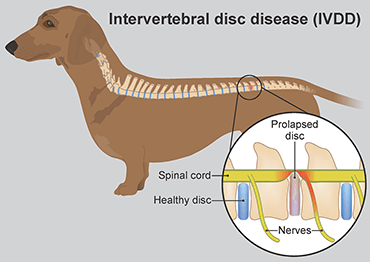
The spine that serves as the back bone for dogs and cats and houses the spinal cord and the spinal nerve root signatures that propogate signals to the nervous system from the brain consist of segmented bones called vertebra. The segmented nature of the spine provides flexibility forming a column of individual mini-joints that are mible in multiple directions. In between each vertebra there is a cartilaginous disc that cushions each intervetebral joint.
When one or more intervertabral discs slip upward toward the canal that houses the spinal cord, compression of the spinal cord and spinal nerves that emanate from it can cause pain, reduced limb, urine and bowel function, and even paralysis. Disc herniation can be the result of inherited anatomical chacteristics that predispose dogs and cats to the injury, trauma, and certain breed conformations. Dog breeds with long torsos tend to be commonly susceptible to spinal disc herniation, including Dachshund, Corgi, and certain types of Hounds. Spinal disc herniation has become increasingly common in French Bulldogs. Shih Tzus are also prone to spinal disc herniation. Spinal disc herniations occur in cats but are significantly less common.
Diagnosis
Diagnosis begins with a physical examination. Patients with spinal disc herniation tend to appear stiff, often hold their heads low, and pain is comonly elicitted when the affected disc is palpated. X-rays are of limited value, as the spinal discs cannot be visualized, imaging as a dark space between each vertebra. A collapsed disc space on x-ray can suggest an area of herniation, but this assessment can be unreliable. To confirm spinal disc herniation and the exact location(s) of herniation, CT scan or MRI are necessary. These imaging techniques require general anesthesia and in most cases, the expertise of a neurologist.
Treatment
It is not uncommon to attempt medical management without the benefit of CT or MRI. If there are not serious accompanying neurological deficits that result from the injury, many spinal disc herniations respond to steroids, muscle relaxers, and strict rest. To increase the chances of medical management success, Class IV therapy laser can be added to the treatment regimen.
For cases where there is partial or complete paralysis, and/or urine or bowel dysfunction, a referral to a neurologist is strongly advised. Herniations that occur between thoracic vertebra 3 through lumbar vertebra 3 have high success rates with decompression surgery. Cervical herniations in the neck area carry more guarded prognoses even with surgery.
Prevention
Preventing dogs and cats from suffering from spinal disc herniations primarily with keeping a lean body condition. Patients that are obese, especially in dog breed genetically susceptible to spinal disc herniation, increases the statistical odds of the injury significantly.
Founder and Chief Editor, Web-DVM.net
Author, The Man in the White Coat
Article updated 8/19/2026

Keep your pets safe this holiday season!
The holiday season is right around the corner starting with Halloween (yes, in my home, we consider Halloween a holiday!). It is both a joyous and busy time and it can be easy to overlook certain...

Help for nervous/anxious dogs
There seems to be a growing number of excessively nervous, often skittish dogs. This can range from anxieties, such as noise or storm anxiety, anxiousness about being separated from pet parents,...
Bird flu is infecting cats and cases are rising – What you need to know!
H5N1 Avian Influenza is causing far more trouble than just just high egg prices. The bird flu has successfully jumped species now able to infect cats and people. Although the ability to infect...
Read Dr. Roger’s Latest Book!

 Be Healthy & Fit With Celebrity Trainer Steve Jordan
- The New Measure of a Life Well Lived: Why Health Span Matters More Than Longevity
- The Wealth Spark: Igniting Your Path To Abundance and Success
- Bright Line Eating with New York Times best selling author Dr. Susan Peirce Thompson
- Maximizing Your Workout Time: Efficiency Tips from Westwood Private Fitness
- How to Transform Your Dad Bod: Insights from the Fit Father Project – New Podcast Episode Out Now!