Why I Am Against Trap Neuter/Spay Release (TNR) For Feral Cats
I would like to begin this article by stating unequivocally that my stance on TNR is not necessarily a negative commentary on individuals and rescue groups that promote this. Their intent is a humane one, to trap wild or feral cats that are so wild that they would not otherwise be adoptable, have them sterilized so that that do not reproduce and contribute to the feral cat overpopulation epidemic, and then release them to live out their lives; as an alternative to euthanasia. The intent to be sure is an honorable one, but it is an approach that from my opinion carries more negative consequences than benefit.
Wildlife Impact
The impact of feral cats on wildlife cannot be overstated. Feral cats are responsible for countless island species extinctions as the result of their efficient hunting for food. The Smithsonian Institute estimates that feral cats are responsible for 14% modern bird, amphibian, and small mammal extinction. As such, they have been named among the top 100 invasive species list.
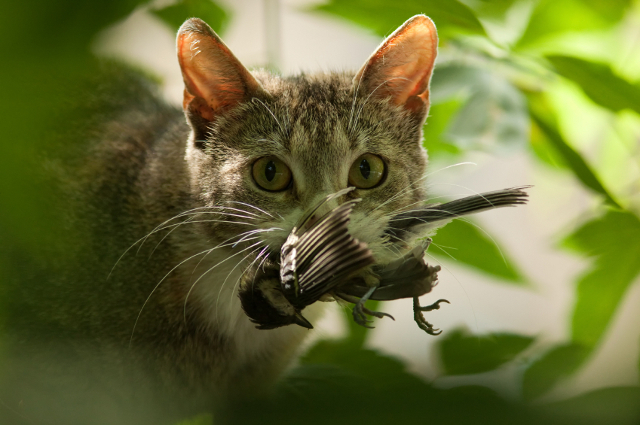
The Smithsonian also estimates that 1.4-3.7 billion birds lose their lives to feline predation each year in the United States. Thus, by enabling the sustaining of feral cat populations and colonies, we are dooming countless small critters to death and even extinction.
Public Health
Feral cats cannot receive regular wellness care and parasite prevention, nor can they receive regular inoculations for rabies, a killer of domestic animals and people. A particular parasite that infects cats called the round worm can infect children 5 years of age or under and reach a stage of larval development that can migrate to their eyes and cause irreversible blindness (called ocular larval migrans). Cats notoriously defecate in children’s sand boxes and other areas of yards where children play and can come in contact with these and other parasites.
Without the benefit of preventive care, feral cats also carry ectoparasites such as fleas and ticks which also harbor infections disease, such as Bubonic Plague and Lyme disease.
Quality of Life
Do feral cats really enjoy a reasonable quality of life? The average life span of an indoor cat is 12-14 years. Compare that to feral cats whose life spans are estimated to rarely exceed 3 years. The reason for the difference is that feral cats live infested with parasites, suffer from untreated infections and painful and immune suppressive periodontal disease, and even themselves fall victim to predation (here in Florida where I live and practice, bobcats are commonly known to kill and eat domestic cats).
Speaking of bobcats, proponents of TNR often point to their and other naturally occurring wild feline populations as proof that cats can adapt and live a good quality of life in the wild. The flaw in this thinking is that truly wild cat species are the result hundreds, even thousands of years of survival of the fittest and have adapted a more intrinsic resistance to parasitism, infections, and periodontal disease, as well as more effectively evade predation.
The Colonies Often Grow
Despite aggressive and committed attempts to use TNR for control of feral feline populations, I have seen many occasions where colonies grow as opposed to shrink over time as is the intent. This is because until the legal system hold people accountable for their cats, people will continue to fail to sterilize their cats, let them out to reproduce, and sadly even outright abandon them when their novelty has run its course. With many feral cat colonies managed by people who feed them, new cats seek these easy sources of food and constantly add new members to existing colonies.
Again, I do not think poorly of people and/or rescue groups that advocate for trap, spay/neuter release programs, as their intent and their heart is thinking of a humane approach to help solve feral cat epidemics that plague many communities. From my point of view, the wildlife, public health, and poor quality of life for feral cats far outweighs any humane benefit, while in many cases propagating the problem.
Dr. Roger Welton is the President of Maybeck Animal Hospital in West Melbourne, FL, Chief Editor of the Veterinary Advice and Information Website, Web-DVM, and founder/CEO of Dr. Roger’s Holistic Veterinary Care.

Keep your pets safe this holiday season!
The holiday season is right around the corner starting with Halloween (yes, in my home, we consider Halloween a holiday!). It is both a joyous and busy time and it can be easy to overlook certain...

Help for nervous/anxious dogs
There seems to be a growing number of excessively nervous, often skittish dogs. This can range from anxieties, such as noise or storm anxiety, anxiousness about being separated from pet parents,...
Bird flu is infecting cats and cases are rising – What you need to know!
H5N1 Avian Influenza is causing far more trouble than just just high egg prices. The bird flu has successfully jumped species now able to infect cats and people. Although the ability to infect...

Read Dr. Roger’s Latest Book!

 Be Healthy & Fit With Celebrity Trainer Steve Jordan
- The New Measure of a Life Well Lived: Why Health Span Matters More Than Longevity
- The Wealth Spark: Igniting Your Path To Abundance and Success
- Bright Line Eating with New York Times best selling author Dr. Susan Peirce Thompson
- Maximizing Your Workout Time: Efficiency Tips from Westwood Private Fitness
- How to Transform Your Dad Bod: Insights from the Fit Father Project – New Podcast Episode Out Now!