Veterinarians Smile And Play With Animals All Day…Not Quite!
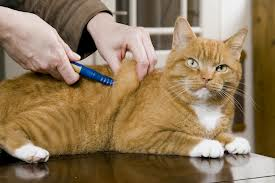
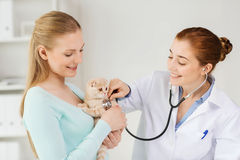 It can be quite humorous when I am reminded how so many perceive what it is like to be a veterinarian. Like the picture here may imply, being a veterinarian in the eyes of many is treating cute and fuzzy creatures all day with owners that are always so grateful that you have the compassion to use your scientific and medical knowledge to care for their innocents. And of course, we smile all day and skip home dripping with anticipation to get back to the animal hospital tomorrow to do it all again.
The reality is quite different, and some of the differences are anything BUT humorous! I will itemize a few of the differences:
- Not all cute and fuzzy creatures are happy to see us, and bite, scratch, and generally try to maim us.
- Not all owners are grateful. Worse yet, some even feel entitled to free care when money is tight because we are veterinarians and should work for free because they said so.
- A big portion of our day is spent analyzing lab data, writing medical notes, and spent on the phone doing call backs.
- Medical cases are sometimes stressful and highly technical.
- Surgeries are sometimes stressful and highly technical.
- We always take work home with us mentally, are paged by the hospital after hours and on days off frequently, and call clients from home or on the road often.
- Losing patients after pouring your heart and soul into saving their lives hurts.
- We have to do business with zero to no business training.
- Did I mention that some patients bite?
- Did I mention that not all owners are grateful?
Don’t get me wrong, I love what I do and I thank the good Lord every day that I get to be a veterinarian. But, it’s not all s–ts and giggles and it can serve up some of the most stressful, nerve racking, and heartbreaking experiences in life. There is a reason that veterinary medicine has the number one suicide rate of any profession.
I bring awareness to this, not because I want pity or to discourage people from pursuing a career as a veterinarian, but so that people understand that while veterinary medicine may be fulfilling, it is difficult and carries as much stress and emotional toll as any profession. With most people that choose veterinary medicine as a career possessing a combination of deep empathy and perfectionist natures, the stress and emotional strain that comes with the job takes a greater toll on the veterinarian than it may for the average person.
So the next time you may feel inclined to judge a veterinarian, understand first that there is a real person with real feelings underneath that white coat that carries a great deal of responsibility on his or her shoulders. While this most certainly does not give the veterinarian license to behave with impunity or accountability, perhaps it may earn us the occasional benefit of the doubt.
Dr. Roger Welton is a practicing veterinarian and well regarded media personality through a number of subjects and platforms. In addition to being passionate about integrative veterinary medicine for which he is a nationally renowned expert, Dr. Welton was also an accomplished college lacrosse player and remains to this day very involved in the sport. He is president of Maybeck Animal Hospital , runs the successful veterinary/animal health blogs Web-DVM and Dr. Roger’s Holistic Veterinary Care, and fulfills his passion for lacrosse through his lacrosse and sport blog, The Creator’s Game.
Veterinary Medicine and Diagnostic Purgatory
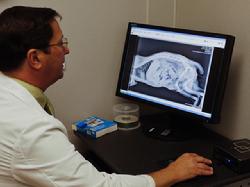 Raised in the Roman Catholic faith, I was introduced with the concept of Purgatory, a place in the afterlife where a sinner must linger while undergoing a cleansing or purification before being allowed full ascension to Heaven. It is neither the torment of Hell nor the bliss of Heaven, but a state somewhere in between neither here nor there. I use the term in veterinary medical diagnostic terms to describe the diagnostic work-up scenario where I have performed a series of diagnostic tests and have not been able to pin point a specific diagnosis. On the other hand, I have also not come up with any bad news per se, unless one considers spending money and running tests with no concrete diagnosis bad news.
The path of diagnostic purgatory begins with patients that cannot speak for themselves and we have to rely on sometimes very subtle clues from the patient’s physical exam and/or behavior (as well as an often imperfect history from the owners) to compile our list of possible diagnoses for what ails the patient. We often get very nebulous histories like “not eating,” ”acting strange,” ”not self.” This is not necessarily the fault of the owner, but may legitimately be the only things that they observe. These signs can be the result of any number possible diseases or ailments.
I was inspired to write this post because I am currently managing what I though a clear cut case of pancreatitis in a King Charles Cavalier Spaniel this week, that is just not coming around to conventional therapy for pancreatitis. The patient was showing all of the hallmark signs of pancreatitis: abdominal pain, vomiting, not eating, etc. The only abnormality in his bloodwork was a strong positive canine PLI, a very accurate blood test for pancreatitis. Yet, 4 days into treatment, he is not coming around with text book pancreatitis in hospital therapy. Subsequently, I have begun x-ray imaging for intra-abdominal lesions that may not reveal themselves in bloodwork but may reveal that the pancreatitis is a secondary consequence of some other disease. X-rays were unremarkable, as were x-rays with a follow up GI series (when we take several abdominal x-rays over severe hours after swallowing a liquid that shows up brightly on x-rays to check for bowel transit time and obstructions of the gut).
This brings me to our last reason for diagnostic purgatory in veterinarian medicine: cost. While in human medicine there most certainly is not an open check to run unlimited diagnostics, with health insurance usually covering at least a portion of the patient’s diagnostics costs, there is a lot more diagnostic leeway. For example, in the aforementioned patient, I would love to run an intra-abdominal CT scan and in the event that was unremarkable, follow up with a PET scan. Both are cost prohibitive for the family of the patient, as they would be for many pet owners. With only 3% of American pet owners carrying health insurance for their pets, the vast majority of the time pet owners are paying directly out of pocket for, or financing the cost of their pet’s health care.
When scenarios like this play out with barely more answers than we had and the patient barely better than he was on presentation, it is frustrating for both owners and doctors alike. As animal health providers that have great empathy for our patients and their owners, take pride in striving to alleviate their suffering, and feel responsible for the emotional and monetary resources a family expends on our animal patient’s care, diagnostic purgatory is a place we despise every bit as much as the loving owner does.
Dr. Roger Welton is the President of Maybeck Animal Hospital in West Melbourne, FL, Chief Editor of the Veterinary Advice and Information Website, Web-DVM, and founder/CEO of Dr. Roger’s Holistic Veterinary Care
What Is Pancreatitis And Why Should Every Dog And Cat Owner Be Aware Of It?
 Having admitted my 5th pancreatitis case in 2 weeks yesterday, I felt the universe was sending me a message that I need to spread awareness about this common disease in dogs and cats. There may not be a whole lot you can do to prevent a first time bout of pancreatitis, but awareness and recognition are very important in heading off this disease while it is still manageable and before very bad things happen.
The chief role of the pancreas in canines and felines is to secrete digestive enzymes to emulsify fats and proteins, and to release insulin and glucagon to regulate glucose (sugar) metabolism. It is the digestive role of the pancreas that concerns us the most with pancreatitis.
Luckily for most dogs and cats, powerful pancreatic enzymes are stored in the pancreas inactive. They activate when they enter the upper small intestine under normal circumstances once the digestive process is initiated. In the case of pancreatitis, inflammation that leads to abnormalities in pancreatic circulation causes the activation of the enzymes while they are still within the pancreas. The result is that the pancreas itself begins to get digested by its own enzymes.
This circumstance is bad enough when it comes to the pancreas alone, but it is not uncommon to see adjacent organ systems such as the liver and gall bladder begin to sustain concurrent damage. Untreated long enough, severe consequences may ensue if the activated pancreas enzymes become blood born.
A severely painful and debilitating syndrome may develop where all of the body’s fatty structures are being digested, a phenomenon called Weber-Christian Syndrome. The worst case scenario is an end stage circumstance called Disseminated Intravascular Coagulation (DIC), a severe bleeding disorder that results from severe body wide inflammation that carries very high mortality rates.
Thankfully, the circumstances outlined in the previous paragraph are quite rare when we catch the disease reasonably early. By reasonably early, I mean within 24-36 hours of onset of clinical signs (see below).
Before we get to clinical signs and treatment, it is first very important who we identify as the highest risk for pancreatitis. Due to inherited abnormalities in fat metabolism, toy breeds, small terriers, and Schnauzers are most at risk. However, I have seen it in all manner of dogs, my most recent that prompted me to write this article, being a King Charles Cavalier Spaniel.
Due to general feline susceptibility to inflammatory bowel disease at the level of the proximal small intestine where the pancreatic duct empties, infection commonly ascends up the pancreatic duct and leads to pancreatitis. As such, all cats are equally susceptible to pancreatitis. Of the 5 cases I have diagnosed in the past 2 weeks, two were cats.
Clinical signs of pancreatitis include vomiting, anorexia, abdominal pain, diarrhea, or some or all of the above. In dogs, it sometimes is preceded by a high fat meal, but this is not always the case and often manifests for no apparent reason. Dehydration, shock and the potential for complications increase exponentially after 24 hours of the onset of clinical signs.
Pancreatitis is diagnosed via blood tests. Pancreatic enzymes that are part of standard blood chemistry profiles are notoriously unreliable for diagnosis of pancreatitis. A more sensitive and accurate blood assay is now commonly employed called a pancreatic lipase immuno0reactivity test, which is available as a SNAP test that is run in hospital within 30 minutes of blood draw. Complete blood count and blood chemistries are also commonly run to assess for complications in other organ systems.
Treatment of pancreatitis consists of IV fluids to rehydrate the patient, restore pancreatic circulation, and flush toxins out of the blood stream and tissues. In addition, the patient is treated with antibiotics to manage concurrent infections, anti-nausea medications, and gastrointestinal protectants. In severe cases where Weber-Christian Syndrome or DIC is suspected, fresh frozen plasma can be administered intravenously.
Once the patient has recovered, the pet’s household needs to be very vigilant in monitoring what the pet has access to for the rest of his/her life. Any food item that is dense in protein or fat could potentially set off a relapse of pancreatitis. Pancreas friendly prescription diets that are low fat, low residue, and restricted in protein are very effective in preventing pancreatitis while still providing the pet with well-balanced nutrition.
Dr. Roger Welton is the President of Maybeck Animal Hospital in West Melbourne, FL, Chief Editor of the Veterinary Advice and Information Website, Web-DVM, and founder/CEO of Dr. Roger’s Holistic Veterinary Care
Veterinary Medicine Has Health Care Right With Integrative Medicine
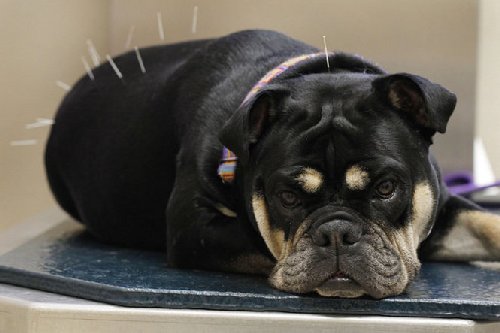 Veterinary medicine seems light years ahead of human medicine when it comes to combining the best aspects of traditional veterinary medicine with proven alternative medicine. When I have asked M.D. friends of mine why they turn such a blind eye to alternative medicine proven to work in animals (who are not susceptible to placebo effect), the answer is surprising. They do not doubt the legitimacy of alternative medicine, they simply cannot go there because health insurance will not cover it.
In veterinary medicine where we are not handcuffed by insurance companies, we have the freedom to advocate for the patient’s best interests, which is to offer the best aspects of traditional western and alternative therapy. What’s more, pet insurance companies (at least the ones not owned by human health insurance companies) like Trupanion, cover acupuncture, chiropractic, nutritional therapy, therapy laser and other proven alternative treatments that have made it into the main stream of veterinary medicine.
Let us take a common example of combining western and alternative medicine. A dog comes in with severe back pain and unstable rear limbs secondary to a compressive intervertebral disc herniation of the spine. In order to immediately manage pain, reduce inflammation, and free up spinal nerves and nerve root signatures, I give an IV injection of a combination of a fast acting steroid and muscle relaxer. The patient will temporarily go home on the oral versions of these medications.
To facilitate the quickest possible weaning of these medications, in order to increase nerve conduction, increase blood supply to the injured area, and thereby facilitate the natural healing properties of the body to stabilize the injury as minimize inflammation long term, I begin a 3 week tapering regimen of acupuncture, therapy laser, and glysosaminoglycan injections.
The premise of integrative veterinary medicine is this: use western medical techniques for humane and medically expedient relief with direct treatment of the disease, while simultaneously propping up the body to do what it does best, which is heal itself. This puts the patient in the best possible circumstances to avoid invasive surgery, wean the patient from dependence on medications, minimize side effects, and facilitate long term health.
Dr. Roger Welton is the President of Maybeck Animal Hospital in West Melbourne, FL, Chief Editor of the Veterinary Advice and Information Website, Web-DVM, and founder/CEO of Dr. Roger’s Holistic Veterinary Care
Veterinary Hospital Offers Clients An Invaluable Glimpse Of Daily Operations
 My proactive and visionary practice manager, Ingrid Culver, conceived the idea of having a hospital open house for fall 2016 and with the coordination our cherished medical team, pulled off a memorable and enjoyable event for all that were involved. An open house is an event where we open the hospital to client tours, pets and families are all welcomed to attend, and there are fun raffles, prizes, giveaways, and of course, food. Of course, dogs are also most welcomed to come and we rewarded them with yummy dog treats and even doggie ice cream! Our turn out of 60 or more people (and at least 30 dogs) exceeded expectations and many in attendance were already excitedly talking about us doing it again next year.
Seeing the facility alone was very eye opening to the clients who were amazed at the level of sophistication of medical equipment, dental and surgical suites, treatment area, and our new boarding kennel. Seeing it first hand really added value to the services we provide in the eyes of the clients and made them evermore excited at the level of medical and surgical options available to their beloved furry family members.
Just as in anything else, there is nothing like seeing how we care for the pets first hand and all that goes into, for example, a spay procedure; something generally perceived by our clientele as routine or even mundane. However, after visualizing the depth of monitoring equipment, crash cart, anesthetic equipment and surgical packs, many clients shared with me that they really never understood a spay as procedure that necessitated such adherence to medical protocol.
I would advise any veterinary hospital owner that is proud of the level of service, surgery, and medicine that they provide, to strongly consider having an open house. I believe the more that we open our doors to the public, the more pet owners will see the value in high quality medicine and be more inclined to bring their pets to facilities like mine rather than consider bargain basement, high volume places for their furry family member’s care.
Dr. Roger Welton is the President of Maybeck Animal Hospital in West Melbourne, FL, Chief Editor of the Veterinary Advice and Information Website, Web-DVM, and founder/CEO of Dr. Roger’s Holistic Veterinary Care.
Extractions Are Not Called Pulling Teeth For Nothing!
Pet owners are occasionally surprised when I quote them the price of dental extractions. I think some people have the impression that the extraction of a tooth is simply yanking on it with a set of pliers, while others tell me that they has their last vet only charge $10 per tooth or some other ridiculously low price. To the former, I say that extracting teeth is intricate and involved oral surgery. To the latter, I say that they should call their old vet back and ask them if they perform the procedure correctly, that is:
1.) Preoperative X-ray.
2.) Gingival Flap.
3.) Sectioning the Tooth (in the case of a multiple root tooth).
4.) Post Operative X-ray.
5.) Suture Closed
To this day, I still have yet to hear that any veterinarian performs tooth extractions at this standard and charges significantly less than I do, although I know of several that charge $10 per tooth and do not even have dental x-ray, let alone perform these other invaluable steps. Each step is equally important to properly extract teeth with minimal pain and complications.
Preoperative X-ray
 This is extremely important first and foremost because, while externally observed dental lesions commonly have damage at the root level, not all do. In addition to confirming that a tooth is indeed a health liability and source of pain, a preoperative x-ray enables the veterinary oral surgeon the opportunity to take precautions in the event of special anatomical considerations. These considerations may include curved roots, ultra-thin jaw bone, or a root located dangerously close to the root of a healthy tooth. Pictured here is a tooth (the largest one in the center) with the root at the right illustrating resorption of the surrounding bone due to damage to the tooth’s crown.
Gingival Flap
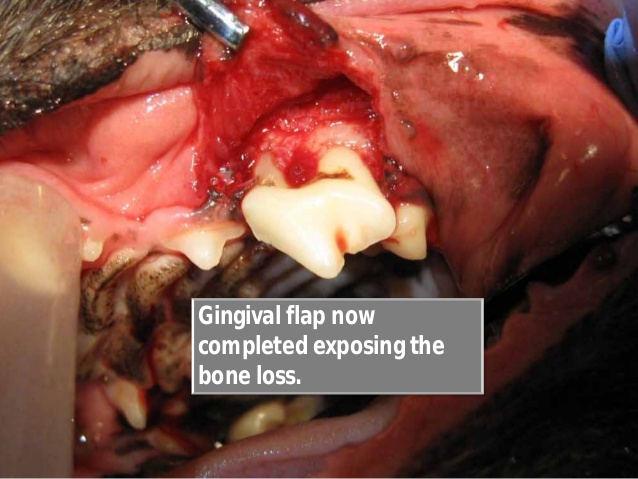 The surgical procedure known as a gingival flap allows for exposure to the bone surrounding the root beneath the gum line. This enables the veterinary oral surgeon access to carefully burr away just the bone immediately surrounding the tooth root. This minimizes damage to the surrounding jaw bone due to the increased precision it permits.
Sectioning The Tooth
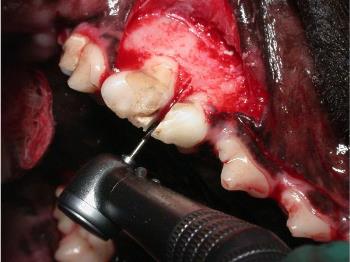 In multi-root teeth, once the roots are exposed, to extract the teeth with the most ease and to avoid breaking of roots during extraction, the tooth is cut or sectioned to enable extraction of one root at a time.
Post-operative X-ray
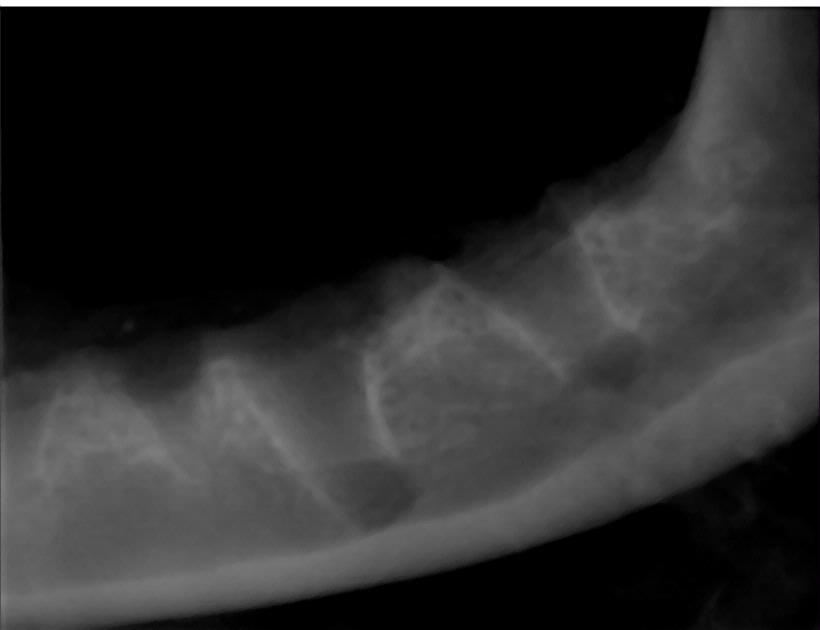 Post-operative x-ray enables the veterinary oral surgeon to confirm that no root fragments were left behind following the extraction. This may be the most important step, as root fragments left behind would be a source of chronic pain and bone infection for month or years to come! In this example, both root spaces are clear with no retained root material.
(See Related: The Number Once Act Of Malpractice In Veterinary Medicine)
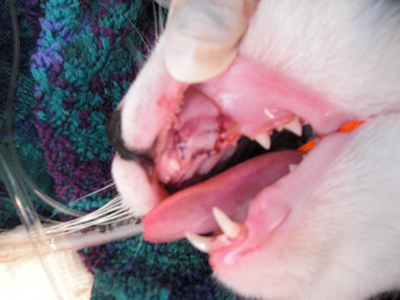 Suture Closed
The gingival flap following an extraction has to be carefully closed so that the gum can heal and seal to the bone once again. Ideally, high grade absorbable suture should be used that has great strength to keep gum tissue opposed in the mouth as it heals, but dissolved in a timely fashion within a few days of complete heal.
Oral surgery for the extraction of diseased teeth is very rewarding for its health benefits to the patient. Decaying teeth are not only a source of pain that a dog or cat suffers silently with, but they are serious lesions that suppress the immune and predispose to kidney failure and heart valve infections. It is not, however, easy. Some of the most labor intensive surgeries that I have been involved in have been oral surgery to extract diseased teeth.
Dr. Roger Welton is the President of Maybeck Animal Hospital in West Melbourne, FL, Chief Editor of the Veterinary Advice and Information Website, Web-DVM, and founder/CEO of Dr. Roger’s Holistic Veterinary Care.
Decided To Gift Your Family With A Family Pet This Holiday Season? Choose Wisely!
 In my previous post, I discussed that giving a pet as a gift is not a good idea, with the exception of a mutually agreed upon step of taking on a new family pet. This is acceptable but to facilitate a favorable outcome, this article has a few important precautions to take.
Dog/Puppy
If you have a family with small children, you really need to give strong consideration for dog breeds or mixed breeds that are tolerant of children. In general, small terriers, Chihuahuas, German Shepherds, Dalmatians, Siberian Huskies and other Spitz breeds, and herding breeds are not good choices to have around children, as they are all known to lack tolerance of children. Lack of tolerance can turn tragic for children and dogs when fear biting comes in to play. This not only leads to potential harm for a child, but also potential for a homeless or even euthanized dog. Golden Retrievers, Labrador Retrievers, Standard Poodles, Beagles, and other hound breeds are generally good choices. Although small and toy breed dogs tend to be in general less tolerant of children, a few are known to be tolerant, especially if socialized and trained early on. Maltese, Toy Poodles, and Havanese breeds have a decent track record in households with small children.
Choose a pet that fits the household life style. Retrievers, Dalmatians, Spitz breeds, and herding breeds are generally active dogs and require a backyard, plenty of exercise, and a constant outlet for their high energy. If that energy is not channeled into regular walks, runs, fetch, swimming and other healthy pursuits, they will find other ways to expend that energy which more often than not are unpleasant.
Cat/Kitten
I generally recommend that families in the market for a new family cat strongly consider adopting adult cats. The reason for this is that feline socialization is an ongoing process that spans the first 2 years of their lives. As such, when approaching 2 years of age, people often find themselves with adult cats that are night and day from the kitten the family had once adopted. This could be a good or a bad thing. With a cat close to 2 years or older, their temperament is generally going to be what a family sees for the duration of his life.
Of course, everyone loves kittens given their energy and playfulness, not to mention their adorableness. If you go this route, be certain to expose the kitten to as many different people as possible and handled as frequently as possible. This will help to aid in optimal socialization and lack of aversion to people and getting handled.
Most people seeking cats are not necessarily looking for a particular feline breed, but for those who are, Abyssinian, Rag Doll, Scottish Fold, and American Shorthair cats are known for tolerant temperaments and good matches for families with children. Persian, Siamese, and Himalayan cats tend to be more one person cats and less tolerant of children.
For run of the mills domestic mutt cats, calico and tortoise coloration tends to favor more skittish and less tolerant temperaments, while tabby coloration tends to favor more tolerant and easy going cats. Males tend to be more cuddly and outgoing then females which may make them better choices for families with children.
Family Training
While choosing a family pet should be thoroughly researched for their tolerance of children and lifestyles that best support them, the family needs training as well to enable a positive transition to having a new pet as part of the family. Children need to be taught the proper ways to handle the new pet and to avoid potentially dangerous games and interactions such as playing tug of ward with a tug toy or touching a dog while eating. Children need to understand the body language of cats for signs when they have had enough petting and/or handling and it is time to let them be. In the case of dogs, hiring a professional dog trainer to come in and instruct the entire family on how to train the dog is a great idea.
Good luck and happy pet hunting this holiday season!
Dr. Roger Welton is the President of Maybeck Animal Hospital in West Melbourne, FL, Chief Editor of the Veterinary Advice and Information Website, Web-DVM, and founder/CEO of Dr. Roger’s Holistic Veterinary Care.
Pets Are Not Smart Holiday Gifts!
 I write about this once a year, so if you have read these sentiments before, my apologies…but since you stumbled across this article anyway, be sure to share the article and these sentiments with everyone you know! And I actually do not apologize, redundancy is the best way to get points across and this is one of the most important points I will make all year!
Aside from the exception of parents planning on surprising the family with a new pet for the holidays, that know full well what they are getting themselves and the family into, gift purchases of pets of any kind are UNWISE to say the least. Pets are living creatures, little lives that are at our mercy when they are chosen to be purchased or adopted.
When we take animals’ lives in our hands, we take on the responsibility of the entire span of their lives. For rabbits, rodents, and pocket pets, this mas be 3 to 5 to even 10 years is some cases. For puppies and kittens this could be 10 to 15 to even 20 years in some cases. For birds, this could be 50 plus years! The point is, there are a lot of years that you take responsibility for when you decide to interject into an animal’s life. Unless you will be the main person solely responsible for the fate of that pet or have a near guaranteed assurance that an animal you home will be well cared for and regarded as a family member, then you have no business offering an animal as a present.
The truth is that the two biggest reasons for pets ending up homeless are 1.) pets purchased as impulse buys and 2.) pets given as gifts. Last year, I had to deal with the aftermath of a retirement aged widow who came in very stressed out over having received the gift of two Shih Tzu puppies from her grandchildren (who are full grown adults). Apparently, in light of the recent loss of her husband, this lady’s grandchildren thought that it would be a good idea to fill the void with 2 new puppies. Good intentions or not, while Grandma made a brave face to act like she just LOVED being gifted with two puppies for Christmas, Grandma was quite oppositely stressed beyond measure.
She told me in no uncertain terms that going about life alone for the first time in several decades was challenging enough, but having to to care for two very high maintenance toy breed puppies was something she would have never asked for. As I went through my physical examinations and discussed puppy health concerns, immunization regimens and proper age to spay/neuter, it seemed that my words barely registered. Before parting, I advised the owner that we would do anything we could to help her properly care for the puppies whether it be medical and/or husbandry advice and training recommendations. This did not evidently alleviate the lady’s anxiety over the puppies.
That was the last time I ever saw that owner or the puppies. Repeated calls and e-mails went unanswered. Although a full year has gone by, it still makes me cringe to think what may have become of those unwanted puppies. I can only hope and pray that she either found the gumption to love and raise those puppies and simply chose to find another vet, or she was able to find a good home for them after all.
Dr. Roger Welton is the President of Maybeck Animal Hospital in West Melbourne, FL, Chief Editor of the Veterinary Advice and Information Website, Web-DVM, and founder/CEO of Dr. Roger’s Holistic Veterinary Care.
Keep Thanksgiving Enjoyable And Safe For Your Dog
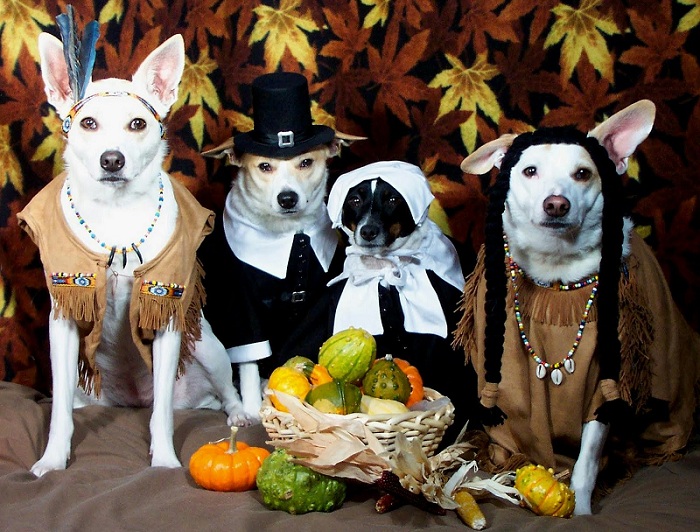 We are all so very thankful on Thanksgiving. We are thankful for our careers, thankful for our health, thankful for our families, and many of us are thankful for our beloved dogs. Naturally, given our love and gratitude for our furry family members, we want them to partake in the enjoyment of the Thanksgiving feast. I understand. And this is okay, provided you follow some common sense guidelines:
1.) Feed only lean cuts of turkey.
2.) Mix in some vegetables if you dog likes them provided they are not over salted or slathered in butter and/or cheese.
3.) If you are a household that enjoys ham as part of the Thanksgiving feast, DO NOT share any with your dog.
4.) DO NOT offer bones of any kind, as they commonly splinter and get stuck in the canine gut.
5.) DO NOT offer dessert of any kind unless it is fruit. Even fruit should be be offered in small amounts, and NO GRAPES.
6.) DO NOT feed highly carbaceous (sorry, I think I invented my own word here) items such as potatoes and pasta, as heavy carbs commonly lead to tummy upset.
7.) DO NOT feed items that are high in fat. Fat not only commonly upsets the tummy, but it can also set off pancreatitis, a severe and debilitating inflammatory disease of the pancreas.
8.) Secure your trash from prying paws!
Despite our best efforts to spread the word about common sense precautions to help your dogs enjoy Thanksgiving without any adverse health consequences, there will inevitably be a long day of fraught with vomiting and diarrhea cases in my veterinary clinic tomorrow. Most vomiting and diarrhea is either self limiting or easily treatable, but for some unfortunates, vomiting especially be a mere symptom of something far worse than just an upset tummy.
I already touched on pancreatitis. This is a common and serious disease that often requires hospitalization. Not a week goes by that I do not see at least one case of pancreatitis and there tends to be a spike in pancreatitis cases around the holidays because it is commonly set off by ingestion of a high fat food item.
Or course, there is the all too common gastrointestinal foreign body obstruction. Bones are our biggest offender here, but I have seen all manner of obstructive items in the gut, including disposable pans and aluminum foil. These cases commonly require surgical removal of stated foreign body.
I bid all of my readers a safe, healthy, and abundant Thanksgiving. I am thankful that so many people actually care to read my writing and listen to my podcast.
Dr. Roger Welton is the President of Maybeck Animal Hospital in West Melbourne, FL, Chief Editor of the Veterinary Advice and Information Website, Web-DVM, and founder/CEO of Dr. Roger’s Holistic Veterinary Care.
Guidelines for giving insulin to pets
 I can’t think of a disease that causes more owner anxiety than diabetes. Something about having to give a shot twice a day, every day, to an animal you love is very daunting. Then you do it a couple times and suddenly, it’s a breeze! I’ll try to help you get “breezy” fast!
Insulin is kept in the refrigerator. Some pens made for humans can be left out for periods of time, but for the most part, plan on refrigerating the insulin. If you have a decent drive to the pharmacy or vet office, bring a little cooler to bring the insulin home. It needs to be gently mixed before each dose. Vetsulin, an insulin made specifically for dogs and cats, can be shaken like a polaroid picture. Other insulins need to be gently inverted in a rocking motion, not shaken like orange juice.
Your veterinarian will show you how to give shots, and make sure you get some practice with saline solution! Here’s some pointers (hoping to have a video soon!):
- We generally aim for the back, between the shoulder, but insulin can be given under the skin anywhere! Try not to hit the exact same place over and over. Some owners move it in a little circle on the back, some do a 4-corners approach. Do what works for you. You basically want a spot that has skin you can easily pinch.
- Pinch the skin with your thumb and middle finger. That leaves your index finger free. If you’re right handed, do this with your left hand. Feel the “tent” of skin that forms from your pinching. That’s where the shot goes.
- After drawing up the insulin and getting the bubbles out, hold the syringe with your thumb and middle finger, leaving your index finger free to depress the plunger.
- Insert the needle completely into the skin. You can part the fur if you want, if the pet is super shaggy, but not a requirement. Once the needle is in, then depress the plunger to inject the insulin. Done!
- Remove the syringe and dispose of safely. Warning! Yes, it is a tiny, wimpy needle. And yes, the plastic cover seems rather thick. Believe me when I say that tiny needle can bend and poke through that plastic cap, poking you and making you bleed like nobody’s business. (not that I’ve done that! LOL)
- You may use an old milk jug or coffee can to keep used syringes. They are meant for one use, no more. I love the Safe Clip – it removes the (sharp!) needle and allows you to throw the syringe in the trash!
If multiple people will be giving the shots, I suggest having a pow wow on measuring the insulin. 3 units to my eyes might look like 3.5 to yours. So, get everyone on the same page.
Pick a time (two times actually, 12 hours apart) and stick with it. Most people do 7 am/7pm or something similar. I have a client who works late and gives the insulin at midnight and noon! Do what works with your schedule. I often feed the animal first, make sure they eat, then give the insulin. Some veterinarians recommend giving the shot 30 minutes before a meal. That makes the most sense biologically, but then what if the pet doesn’t eat? You have insulin in them that you can’t get out! And now we worry about their blood sugar dropping too low. If we make sure they eat before giving the shot, that’s a non-issue.
Here’s how to handle other common questions:
- You have 1 hour on either side of that time you chose to give the insulin shots. So if you chose 7 am/pm, then between 6 and 8 is acceptable. Obviously, giving it at 7:00 on the dot is ideal, but sometimes life gets in the way. Also, if you have to give it at 8 one time, do not make the next dose at 6. Try to get as close to 12 hours apart as you can.
- If you have to give a shot earlier or later than that window, better to skip that dose. I’d rather have your pet have high blood sugar (not a huge deal) than risk him getting too low (very bad!) by getting shots too close together.
- If you give a shot, and your pet moves, making you not so sure it actually went in, don’t panic. Also, do not give another shot. Again, better to have a missed shot than get a double dose!
- If multiple people in the house are responsible for giving the shots, have a paper or dry erase board to check off when the shot was given, to avoid any double dosing.
How can you tell if it’s working? How do you know when to worry? coming up are my articles on monitoring and diet as well!
Web-DVM guest blogger Dr. Karen Louis is a practicing small animal veterinarian. See more of her articles at her blog at VetChick.com

Keep your pets safe this holiday season!
The holiday season is right around the corner starting with Halloween (yes, in my home, we consider Halloween a holiday!). It is both a joyous and busy time and it can be easy to overlook certain...

Help for nervous/anxious dogs
There seems to be a growing number of excessively nervous, often skittish dogs. This can range from anxieties, such as noise or storm anxiety, anxiousness about being separated from pet parents,...
Bird flu is infecting cats and cases are rising – What you need to know!
H5N1 Avian Influenza is causing far more trouble than just just high egg prices. The bird flu has successfully jumped species now able to infect cats and people. Although the ability to infect...

Read Dr. Roger’s Latest Book!

 Be Healthy & Fit With Celebrity Trainer Steve Jordan
- The New Measure of a Life Well Lived: Why Health Span Matters More Than Longevity
- The Wealth Spark: Igniting Your Path To Abundance and Success
- Bright Line Eating with New York Times best selling author Dr. Susan Peirce Thompson
- Maximizing Your Workout Time: Efficiency Tips from Westwood Private Fitness
- How to Transform Your Dad Bod: Insights from the Fit Father Project – New Podcast Episode Out Now!